
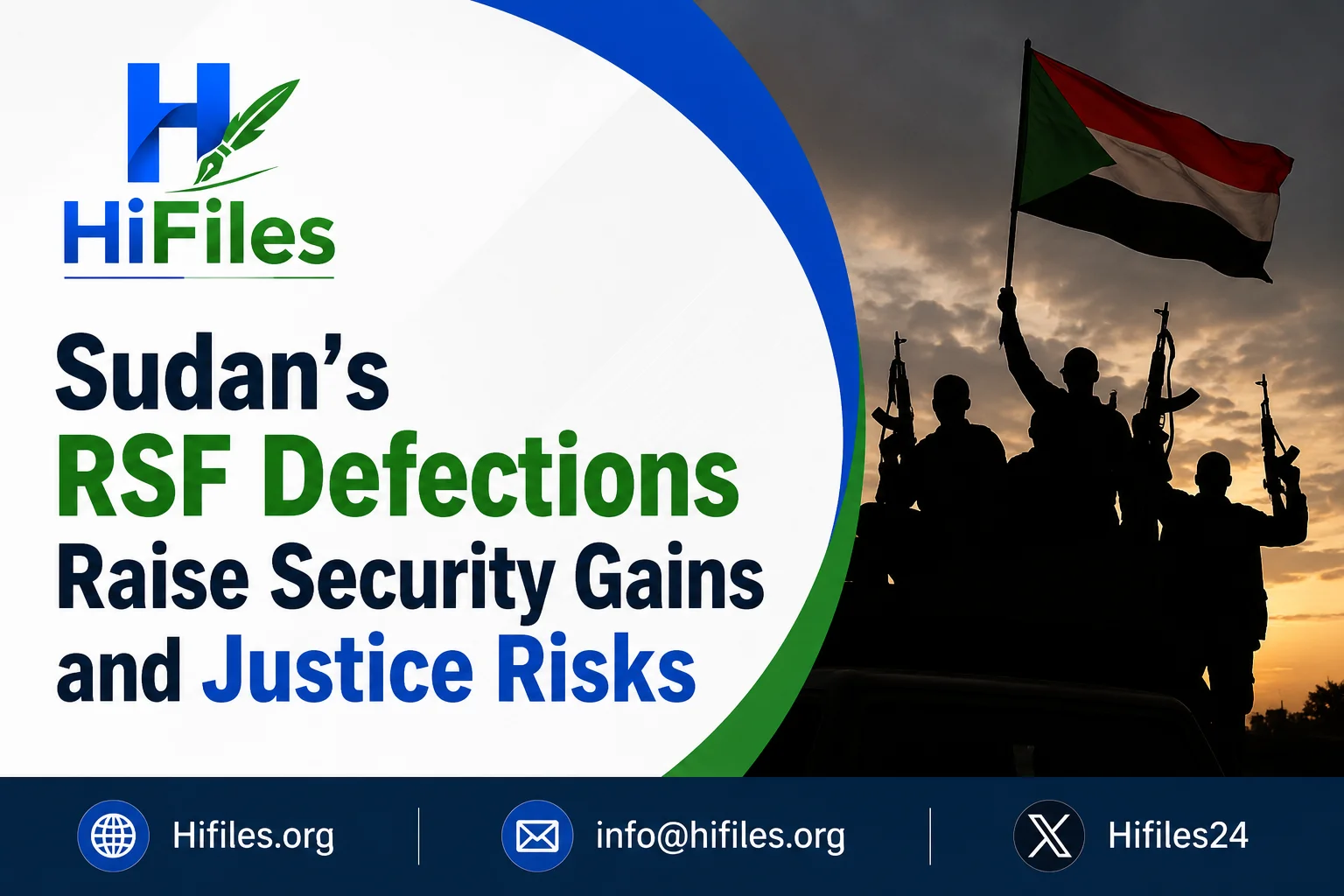
SUDAN’S RSF DEFECTIONS RAISE SECURITY GAINS AND JUSTICE RISKS
The Sudanese military's exploitation of RSF defections may deliver operational advantages, but unresolved allegations of atrocities risk undermining reconciliation, public trust, and post-conflict stability
Overview
𝐒𝐮𝐝𝐚𝐧’𝐬 𝐑𝐒𝐅 𝐃𝐞𝐟𝐞𝐜𝐭𝐢𝐨𝐧𝐬 𝐑𝐚𝐢𝐬𝐞 𝐒𝐞𝐜𝐮𝐫𝐢𝐭𝐲 𝐆𝐚𝐢𝐧𝐬 𝐚𝐧𝐝 𝐉𝐮𝐬𝐭𝐢𝐜𝐞 𝐑𝐢𝐬𝐤𝐬
𝐎𝐧 𝐉𝐮𝐧𝐞 𝟐𝟑, 𝟐𝟎𝟐𝟔 The defection of senior Rapid Support Forces (RSF) commanders to Sudan’s army-aligned authorities has created a complex security dilemma: while the military may gain tactical and intelligence advantages, many victims and civil society actors fear that alleged perpetrators of grave abuses could be absorbed into official structures without accountability.
According to Reuters reporting, former RSF commander Ali Rizkallah, widely known as “Savannah,” was welcomed in Khartoum and given a uniform and rank after defecting from the paramilitary group. Other senior figures, including North Darfur commander al-Nour Guba, have also reportedly switched sides. These defections are being presented by army-affiliated authorities as strategic gains in Sudan’s war, which began in April 2023 between the Sudanese Armed Forces and the RSF.
From a security perspective, such defections can provide the army with operational intelligence, knowledge of RSF command networks, supply routes, tribal alliances, and battlefield vulnerabilities. They may also weaken RSF cohesion by exploiting internal divisions. However, this approach carries serious protection, legitimacy, and transitional justice risks.
Victims in Darfur and Kordofan have expressed anger that former RSF commanders are being publicly welcomed while communities continue to live with the trauma of killings, rape, looting, displacement, and intimidation. Reuters reported testimony from survivors who said they could not forgive RSF fighters because of what they witnessed during attacks. These voices show that battlefield reintegration without justice may deepen social resentment and undermine public trust in state institutions.
The issue is not only military. It is also a rule-of-law challenge. If former commanders accused of abuses are integrated into official security structures without investigation, vetting, or judicial review, it could create a perception of impunity. That perception can fuel grievance, discourage cooperation with authorities, and weaken community confidence in stabilization efforts.
Security-sector reform requires more than changing uniforms. It requires accountability mechanisms, command responsibility reviews, human rights screening, and credible civilian protection safeguards. Former combatants who defect should not automatically be treated as legitimate security actors unless their conduct is assessed through a transparent legal process.
Human Rights Watch has also warned that amnesty or political deals should not be used to deny accountability for serious crimes, including extrajudicial executions, sexual violence, enforced disappearances, torture, and other grave violations. This is especially important in Sudan, where the conflict has displaced millions and exposed civilians to famine, disease, and repeated attacks.
The army may see short-term military benefit in encouraging RSF defections, particularly if such moves weaken paramilitary command cohesion. But if the process ignores victims, it risks creating long-term insecurity. Communities that feel abandoned by justice mechanisms may resist reconciliation, reject state authority, or support alternative armed protection networks.
A balanced approach is needed. Sudanese authorities and international partners should separate tactical defection from legal accountability. Commanders who defect can provide intelligence or support ceasefire efforts, but they should still be subject to investigation where credible allegations exist. The same standard should apply to all armed actors, regardless of whether they are aligned with the army or the RSF.
For Sudan’s future stability, the central question is not only who controls territory, but whether civilians believe that security institutions protect them. Without credible accountability, defections may shift the battlefield while leaving the roots of violence untouched.
References Reuters, “Anger mounts as Sudan’s army takes in Darfur paramilitary defectors,” reported by Nafisa Eltahir and Alexander Dziadosz, June 2026.
Reuters report republished by Internazionale Human Rights Watch, “Sudan: Hold Defecting Armed Group Commanders to Account,” June 10, 2026. Human Rights Watch
𝐁𝐲 𝐇𝐢𝐟𝐢𝐥𝐞𝐬 𝐒𝐞𝐜𝐮𝐫𝐢𝐭𝐲 𝐃𝐞𝐬𝐤