
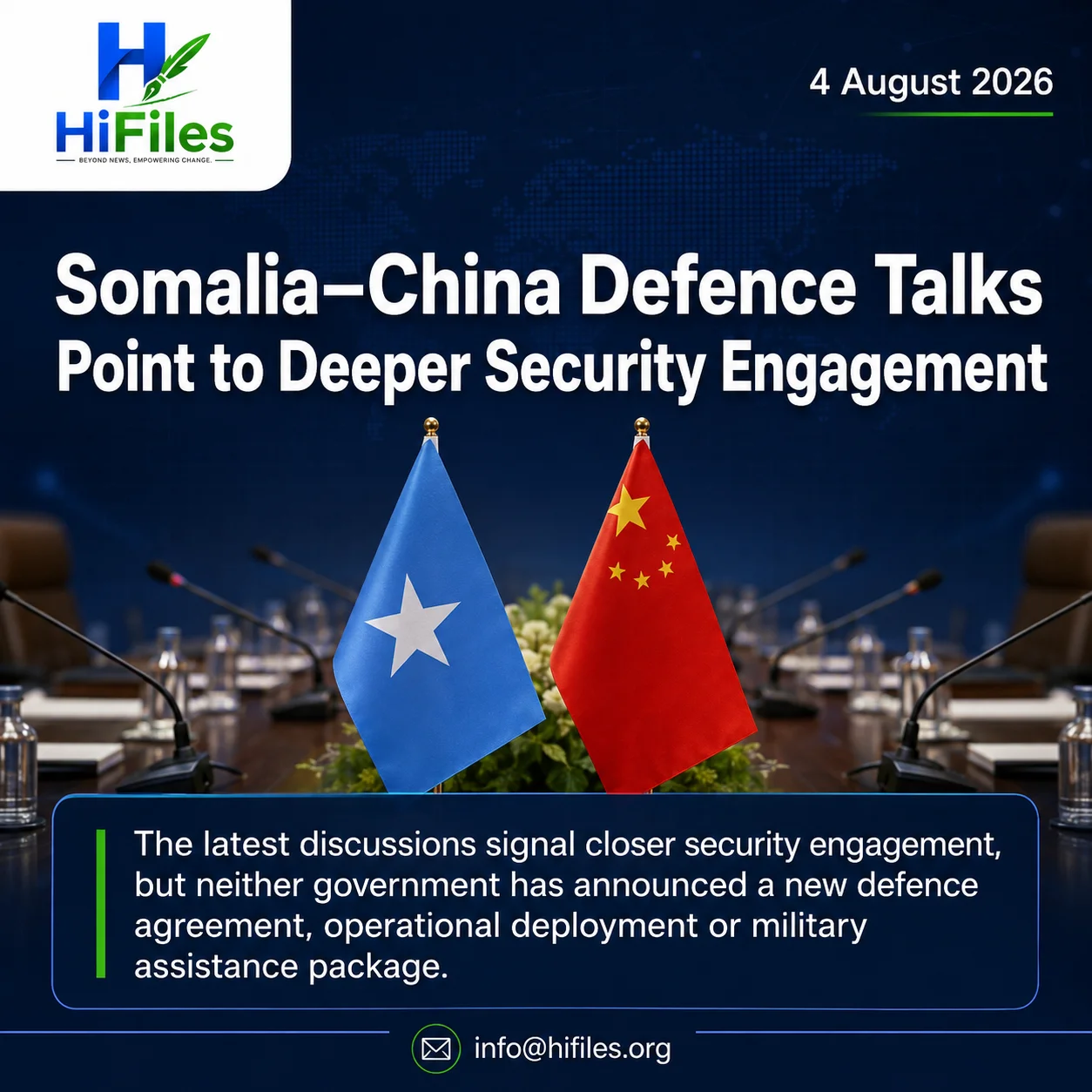
𝐒𝐨𝐦𝐚𝐥𝐢𝐚–𝐂𝐡𝐢𝐧𝐚 𝐃𝐞𝐟𝐞𝐧𝐜𝐞 𝐓𝐚𝐥𝐤𝐬 𝐏𝐨𝐢𝐧𝐭 𝐭𝐨 𝐃𝐞𝐞𝐩𝐞𝐫 𝐒𝐞𝐜𝐮𝐫𝐢𝐭𝐲 𝐄𝐧𝐠𝐚𝐠𝐞𝐦𝐞𝐧𝐭
The latest discussions signal closer security engagement, but neither government has announced a new defence agreement, operational deployment or military assistance package.
Overview
𝐇𝐈𝐅𝐈𝐋𝐄𝐒 𝐒𝐞𝐜𝐮𝐫𝐢𝐭𝐲 𝐃𝐞𝐬𝐤 | 𝟒 𝐀𝐮𝐠𝐮𝐬𝐭 𝟐𝟎𝟐𝟔
Somalia and China have agreed to continue discussions on defence cooperation, counterterrorism and institutional support following a meeting in Mogadishu between Somali Defence Minister Ahmed Moallin Fiqi and Chinese Ambassador Wang Yu.
According to Somalia’s Ministry of Defence, the 8 June meeting addressed strategic military cooperation, the campaign against al-Shabaab and measures to strengthen Somalia’s security institutions. Minister Fiqi thanked China for supporting Somalia’s sovereignty, unity and territorial integrity. Ambassador Wang praised the Federal Government’s counterterrorism efforts and work to restore stability.
The meeting represents a gradual expansion of bilateral security relations rather than the formation of a new alliance. Neither government disclosed a signed agreement, equipment package, training programme or deployment plan.
𝐖𝐡𝐲 𝐢𝐭 𝐦𝐚𝐭𝐭𝐞𝐫𝐬
Somalia is seeking a broader range of security partners as its forces assume greater responsibilities under the African Union Support and Stabilisation Mission in Somalia transition.
China has previously provided Somalia with non-lethal military equipment, police assistance and diplomatic support. Future cooperation could involve training, transport, communications, medical support, engineering or security infrastructure. However, no new assistance package has been confirmed.
China is unlikely to replace AUSSOM or Somalia’s established international security partners. A more likely role would involve selective institutional and logistical support without a large Chinese operational presence.
Somalia will need to coordinate any additional assistance carefully. Poor coordination could produce incompatible equipment, fragmented training programmes and overlapping responsibilities among international partners.
𝐎𝐮𝐭𝐥𝐨𝐨𝐤
During the next six to twelve months, continued senior-level discussions and limited capacity-building activity are the most likely outcomes. A modest non-lethal assistance package is possible, but there is no public evidence of plans for a permanent Chinese military base, Chinese combat deployment or major arms agreement.
The more immediate concern remains the AUSSOM transition. If financing, logistics and Somali force readiness keep pace with operational requirements, security responsibilities can be transferred gradually. If these areas fall behind, al-Shabaab could exploit emerging security gaps.
𝐇𝐈𝐅𝐈𝐋𝐄𝐒 𝐀𝐬𝐬𝐞𝐬𝐬𝐦𝐞𝐧𝐭
The talks indicate a measured deepening of Somalia–China defence relations. Their practical importance will depend on whether diplomatic commitments produce coordinated and sustainable support for Somali security institutions.
This report is based on open-source reporting, official government statements and public records from the African Union and the United Nations. The complete HIFILES Strategic Security Assessment—including the incident chronology, risk analysis and six-year outlook matrix—is available in the attached PDF.